
Enabling everyone is the only way to scale with AI
Today, most organizations work inefficiently. Not because they want to, but because the way their work is designed has become outdated.

They usually have a central technology department that is supposed to solve everyone’s problems. That is based on an old model where solving technical problems was the job of a select few.
But that has changed in just the last few years.
Leave your tech team for what matters most
There aren’t enough Devs for everything that can be automated today. Their value lies in the complex, the large-scale, the deep, the structural.
That’s why our view is that you have to enable AI across the whole organization in a smart way, and we’re not talking about simply buying licenses nobody is going to use either. There are tons of things you can do without writing a single line of code, but you need to train people across the organization at every level.
That way, you leave the GI Joe teams for what’s important.
It’s important to spread that load to operate much better. To optimize the day-to-day.
Think of it this way
To enable everyone with technology, picture the layers of an onion.
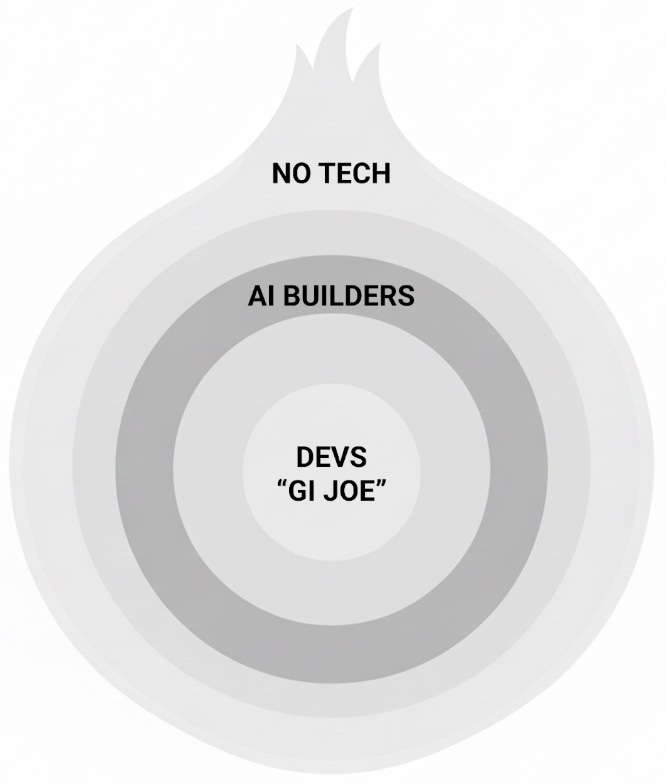
The core
At the core you have the Devs, the GI Joes, the ones who always solve the complex, the large-scale, whatever has a deep, cross-cutting impact.
The middle layer
In the middle layer are the “AI builders”: junior Devs who can implement solutions without writing a line of code, but who think like developers. Cross-functional, large-scale or medium-complexity solutions for the whole company, using and implementing existing automation tools, workflows and AI integrations.
The outer edge
And in the outer layer is everyone else, the people on your team with no technical knowledge. But if you support and guide them, they can create their own automations and become far more efficient on their own, solving the problems in their own corner of the business with AI.
When you get these three layers in place, you enable everyone.
The organization becomes much more efficient, and you spare IT from getting requests that will end up in the backlog (that unfathomable antimatter void where things slowly die for all eternity)…
People do things on the computer that they no longer need to do, and on top of that, they now use AI for tasks that have no impact on the P&L. With our training, we help them understand the potential of technology. They understand what they really need to do and what they don’t.
Don’t just train people, really support them
Learning by doing is the only option. Training alone doesn’t change habits; hands-on support does.
There are two steps:
- Enable
- Support and train on real work
A one-off training session isn’t enough. If you only teach how to do things and don’t support people along the way, they won’t apply it and won’t truly solve the problems.
Hands-on support is key. It’s an investment you recover in less than a month of the team’s work.
And I say this because I’ve seen it. The people we train get excited about the results and solve problems they couldn’t solve before.
And most importantly: they free up time for higher-value tasks that actually impact the P&L.
Why it works
Let’s go back to the onion. If you put it into practice, this is what you achieve:
- Each person can build their own solutions for their own corner of the business, making their work more efficient.
- The Builders in the middle layer solve problems by integrating and implementing existing automation and AI solutions in a maintainable, sustainable way, because they have technical knowledge and work within the lines IT defines, but above the individual level.
This way you build the ability to “solve with technology” from the top down, in every layer of the onion, including everyone in the process in a faster, more efficient way.
Why now
Everyone should be doing the same thing NOW… Because the company next door that competes with you is already doing it… The question is NOT whether you’re going to use AI. It’s whether you’re going to remain the same organization you were in 2010.
In 2026 this will become an essential task, not an optional one.

Co-founder Teamcubation. Follow me on LinkedIn.